2-Player Strategy Card Games for a Night In

Do you take one more trick, even when winning too many could cost you? Start an expedition before you feel ready? Spend your coins on a curious market find when the person across the table seems suspiciously uninterested?
If those choices sound more fun than simply hoping for a lucky draw, you’re in the right place. These 2-player strategy card games come with their own cards and rules, rather than using a standard deck of playing cards. They offer different kinds of rivalry, from deciding when to win a trick to trying to read the person sitting opposite you.
Three games, three kinds of strategy
The Fox in the Forest, Lost Cities and Moonlight Market are three interesting places to begin. Each gives two players something to plan, but what you’re watching changes from game to game.
| What you want to decide | What it feels like at two | A game to try |
|---|---|---|
| Win this trick or deliberately let it go | A clever contest where winning too much can backfire | The Fox in the Forest |
| Start a new expedition or hold on to your cards | A quieter contest of commitment and patience | Lost Cities |
| Spend your coins or keep them for a later opportunity | A secret-bid duel where intentions are hard to read | Moonlight Market |
In The Fox in the Forest, you play tricks against one other person using cards with special abilities inspired by fairy tales. But there’s a catch: taking too many tricks can cost you points. Do you play a strong card now or hold back and let your opponent take this one? It’s a lovely twist for two players who enjoy tactical choices, especially when the obvious move isn’t always the clever one.
Lost Cities creates a different sort of hesitation. You’re building expeditions through cards, and beginning one is a commitment. Do you get started with the cards you have or hold back until the route looks more promising? You can understand the dilemma quickly, even when the right answer takes much longer to work out.
Then there’s Moonlight Market: The Secret Collector Auction. Here, illustrated fantasy objects come up for secret bidding, and each player has a hidden collection goal. An object that looks rather unremarkable to you may be exactly what the other person wants. Or perhaps they’re hoping you’ll think that. The tension comes from weighing what to risk without seeing the other player’s plans. And if no one is free to join you, Moonlight Market has an optional AI player whose poker face gives absolutely nothing away.
Choose the kind of decision you’d enjoy making again, even after your first plan goes spectacularly wrong.
Easy to learn, harder to predict
Start with the decision you’ll make most often. Can someone explain the basic choice in an ordinary sentence? In The Fox in the Forest, you decide which tricks to pursue and which to let go. In Lost Cities, you decide when to commit cards to an expedition. In Moonlight Market, you weigh whether an object is worth a secret bid. The finer points matter once you’re playing, but that first decision tells you a lot about the experience.
Easy to learn doesn’t mean predictable. Two players can understand the same straightforward choice and make completely different plans. One plays cautiously; the other takes a chance. That’s where the rivalry begins.
Think about your evening too. Would you rather chat as you play or quietly study the table? Build toward a long-term payoff, or see things change immediately? Those answers matter more than finding one universal ‘easiest’ strategy game. If you’d enjoy following clues together, our guide to mystery games for adults can help you pick a case.
The tension of a secret bid
Picture an unusual object at a night market. It might suit your collection. You have coins to spend, but more opportunities are coming. Across the table, the other player looks completely relaxed.
Do you risk more now or hold something back for later? The other player makes a choice too, without showing you their intention first. And because their collection goal is hidden, a quiet face tells you very little. That’s what makes secret bidding so different from simply taking the best visible card. You’re deciding what something is worth to you, while guessing what it may be worth to someone else.
The real fun is in the rematch
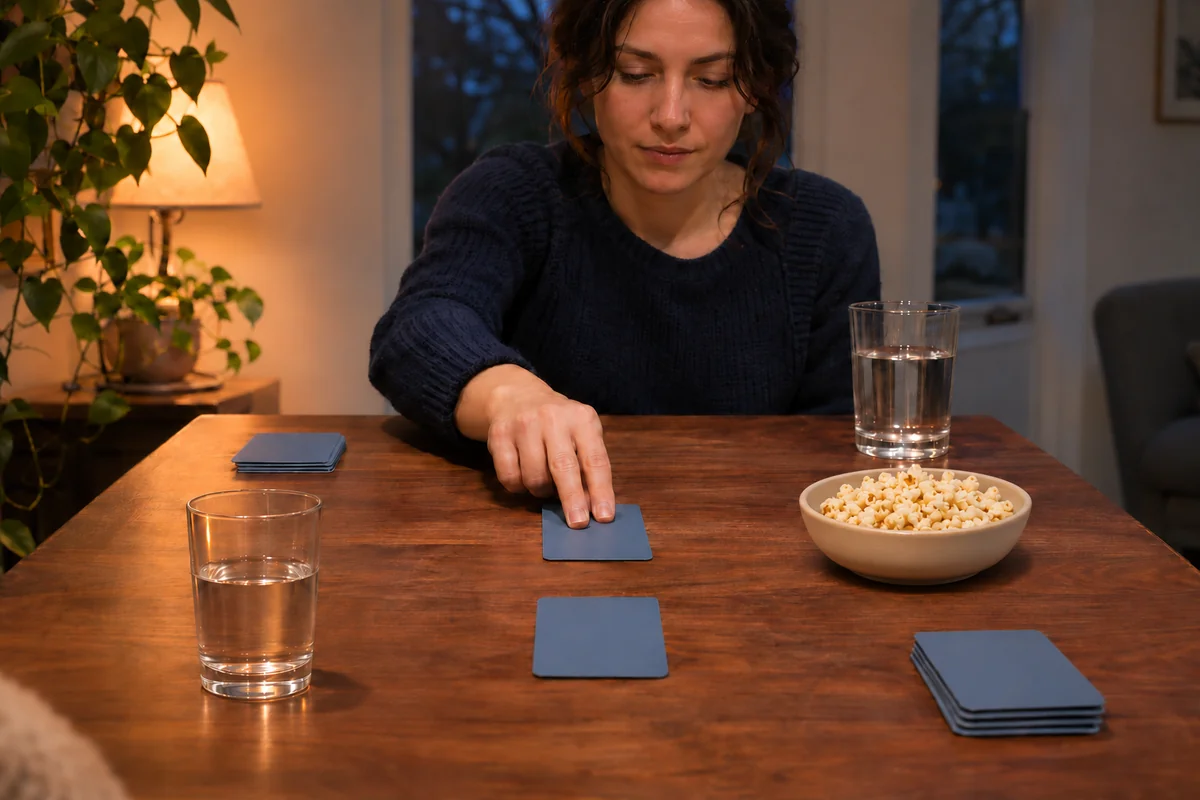
There’s a particular kind of silence when both players are considering their next move. One person studies the cards. The other watches the person studying the cards. Neither is quite as subtle as they think.
That’s part of what makes a strategy card game for two so absorbing. You aren’t only considering the cards in front of you. You’re learning how someone else makes decisions, and they’re doing exactly the same to you. A choice that seemed perfectly sensible a moment ago can look rather different once you see what they were planning.
And then the game ends. Maybe you wish you’d held back one more turn. Maybe the bold move you were so pleased with wasn’t nearly as clever as it felt. The person across the table, naturally, has their own interpretation.
Which is why a rematch can be more tempting than moving on to something else. The cards are familiar now, but you can try a different approach. Be unexpectedly cautious. Take the risk you avoided last time. See whether the other person has figured you out, or merely thinks they have.
You don’t need an elaborate game night to get that feeling. Find a game with decisions you’d enjoy arguing about afterward, make a little room at the table, and play. If the first game ends with someone saying, “Again?”, you’ve probably chosen well.